
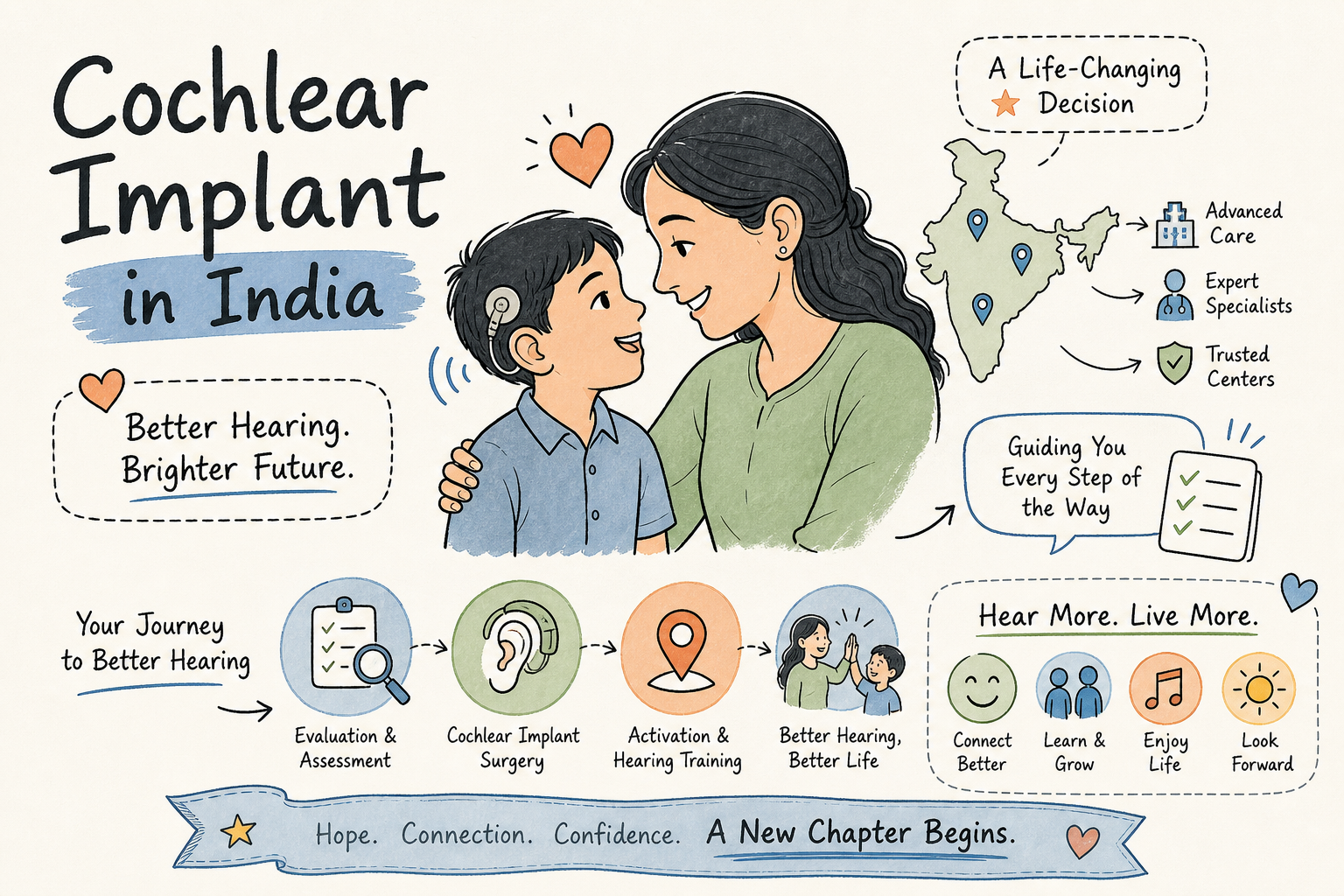
When families in the United States are told their child needs a cochlear implant, the first number they usually hear is somewhere between $50,000 and $100,000. For adults with profound hearing loss who have exhausted hearing aids, that figure can feel like a door closing. What many don’t realize until they start researching is that cochlear implant surgery in India, using the same globally manufactured devices, performed by surgeons with formal cochlear implant surgical training from recognised national and international cochlear implant institutions, in addition to fellowship training in otology and neuro-otology, is available for a fraction of that price. Single-ear cochlear implant device costs in India range from ₹6 lakh to ₹20 lakh. That’s not a compromise. That’s a different healthcare cost structure producing the same clinical outcome.
This guide answers every practical question families and NRI patients ask before making this decision. You’ll find cost breakdowns by hospital type and device brand, a clear explanation of the ADIP government funding scheme and who qualifies, a framework for evaluating surgeons and cochlear implant centres in India, and a realistic timeline for what surgery and rehabilitation actually involve. At Adventis ENT & Cochlear Implant Clinic in Greater Kailash, Delhi, we work through this exact journey with Indian families and international patients every week. By the end of this guide, you’ll have everything you need to move forward with confidence.
- Why India Has Become a Serious Destination for Cochlear Implant Surgery
- What Cochlear Implant Surgery in India Costs
- Government Funding Routes That Can Reduce Costs Significantly
- How to Find the Right Cochlear Implant Centre and Surgeon
- SpHear Cochlear at Adventis ENT Clinic
- What to Expect Before, During, and After Your Surgery
- Device Options Available in India and How to Compare Them
- Making Your Decision: A Clear Path Forward
Why India Has Become a Serious Destination for Cochlear Implant Surgery
The cost difference between India and the US is not marginal. With single-ear cochlear implant device costs in India ranging from ₹6 lakh to ₹20 lakh versus $50,000 to $100,000 in the US, patients typically save approximately 65 to 80 percent based on published package comparisons. Critically, the Indian figure is a package cost: it includes the implant device itself, surgical fees, hospital stay, pre-operative assessments including CT and MRI, and initial auditory mapping sessions. The device, whether a Cochlear Nucleus 8, MED-EL SYNCHRONY, or Advanced Bionics Marvel CI, is the same hardware used in American and British hospitals, procured through the manufacturers’ Indian subsidiaries. The savings come from lower surgical fees, hospital overhead, and professional charges, not from cutting corners on technology.
India’s top cochlear implant surgeons hold credentials that stand up to international comparison. They possess internationally recognised training, operate within JCI- or NABH-accredited hospital environments, and frequently hold elite qualifications. At Adventis ENT & Cochlear Implant Clinic, Dr. (Prof.) Ameet Kishore brings dual Royal College of Surgeons fellowships alongside 30 years of dedicated cochlear implantexperience, the kind of internationally recognised training that NRI and international patients are specifically looking for. Delhi/NCR, Chennai, Mumbai, Bangalore, and Hyderabad all have established, high-volume cochlear implant hospitals in India delivering outcomes that compare directly to published UK and US data.
Published Indian data supports this position. Reported surgical success rates in Indian series typically range from 80 to 95 percent, with some large-volume centres and long-term device survival studies exceeding 95 percent, consistent with the global range seen in the US and UK. One long-running South Indian cochlear implant programme reported a cumulative device survival rate of 96.5 percent across two decades of cases. For pediatric recipients, clinical data from Indian programmes shows 80 to 90 percent of children achieve significant hearing and speech improvement within one to two years of implantation when rehabilitation is consistent. These are peer-reviewed outcomes from programmes with hundreds of cases each.
What Cochlear Implant Surgery in India Costs
Costs by Hospital Type
Government and public hospitals, including AIIMS Delhi, are the lowest-cost option for Indian citizens, often with substantial subsidies for low-income families. For international patients, the same public facilities charge full rates. Across the country, single-ear cochlear implant device costs in India range from ₹6 lakh to ₹20 lakh. Private and super-specialty hospitals feature comprehensive packages that typically bundle CT and MRI scans, a one- to two-day hospital stay, the device, surgery, and initial mapping sessions. City-level pricing varies too: Delhi and Chennai tend to sit slightly lower than Mumbai for equivalent services.
Costs by Device Brand
The device itself accounts for 60 to 80 percent of the total bill, which is why brand selection materially affects your final cost. The cochlear implant device costs vary by manufacturer; options available in India from global leaders include Cochlear, MED-EL, and Advanced Bionics. A cochlear implant device consists of an internal implant and an external sound processor (the internal implant is not sold separately). The Indian package rates compress the total significantly because surgeon fees, anaesthesia, hospital bed charges, and audiologist time are priced according to Indian healthcare economics, not American ones.
Several additional costs require budgeting. Pre-operative assessments run ₹10,000 to ₹30,000 ($120 to $360) depending on the centre and required investigations. Surgical Fees and Hospital Packages are approx. INR 2 to 3 Lacs. Auditory rehabilitation for the first post-implant year typically costs ₹50,000 to ₹1,500,000 ($600 to $1,800). Bilateral implantation (both ears) adds 50 to 70 percent to the base figure. For NRI and international patients, accommodation in Delhi for a 10 to 15 day stay, plus round-trip travel, should also be factored in. Before committing to any programme, request an itemised package quote in writing so you know exactly what is and is not included.
Government Funding Routes That Can Reduce Costs Significantly
The ADIP Scheme
The Assistance to Disabled Persons (ADIP) scheme, implemented through the Ali Yavar Jung National Institute of Speech and Hearing Disabilities (AYJNISHD) in Mumbai, is India’s primary government programme funding cochlear implants (official ADIP scheme guidelines (English PDF)). Coverage reaches up to ₹7 lakh per unilateral implant for pre-lingual bilateral severe-to-profound hearing loss in children aged 1 to 5 years, and up to ₹6 lakh for acquired hearing loss in children aged 5 to 18 years. Families earning ₹22,500 per month or less receive 100 percent coverage; those earning between ₹22,501 and ₹30,000 per month receive 50 percent. The scheme requires no additional disabilities, a completed 3 to 6 month hearing aid trial with documented lack of benefit, and a firm commitment to 12 months of post-implant rehabilitation.
ADIP Eligibility and Application Steps
Applying through the ADIP scheme follows a clear sequence:
- Complete an audiological assessment and obtain a disability certificate at AYJNISHD or an empaneled centre.
- Submit your application through adipcochlearimplant.in with proof of identity, income proof, medical records, and hearing aid trial documentation.
- AYJNISHD reviews and allocates funding based on eligibility.
- Surgery is scheduled at one of the 219-plus empaneled hospitals listed on the DEPwD ADIP portal.
- Post-operative rehabilitation sessions run for 12 months; reapplication is permitted after three years (one year for children under 12).
The ADIP helpline at 1800-180-0033 can clarify current income thresholds, as these are revised periodically.
State Supplementary Programmes
Several states run supplementary programmes that layer on top of the central ADIP allocation. Telangana covers cochlear implants for BPL families earning under ₹2 lakh annually, with state funding reported at up to ₹5 lakh. Karnataka, Maharashtra, and Tamil Nadu each run aligned schemes that have provided ₹3 to 7 lakh for qualifying families, pushing combined coverage close to or beyond full cost for many eligible recipients. These figures are updated independently of the central scheme; check your state’s DEPwD portal directly to confirm the current amounts and eligibility criteria before applying.
How to Find the Right Cochlear Implant Centre and Surgeon
The credentials that matter most are formal cochlear implant surgical training from recognised national and international cochlear implant institutions, in addition to fellowship training in otology and neuro-otology. Beyond the surgeon’s qualifications, the hospital should hold JCI or NABH accreditation.
A cochlear implant programme should be evaluated as a complete multidisciplinary service rather than simply a surgical procedure. The best outcomes are achieved when the surgeon works as part of a dedicated cochlear implant team that includes audiologists, auditory-verbal therapists, rehabilitation specialists and programme coordinators. Families should look for centres that conduct regular multidisciplinary team meetings and joint consultations where the surgeon, audiologist and therapist assess patients together, discuss progress collectively and create coordinated treatment plans.
Patients should verify that the surgeon works closely within an established cochlear implant team and participates in regular multidisciplinary meetings with audiologists and therapists. Centres that provide coordinated team-based care generally deliver a more comprehensive cochlear implant experience than programmes centred around a single operator. Annual implant volume is also a meaningful indicator: higher-volume cochlear implant centres in India tend to have more refined protocols, more experienced audiologists, and better complication management than lower-volume programmes.
Questions Patients Should Ask
Before committing to any programme, ask these questions directly:
- Does the surgeon work as part of a dedicated cochlear implant team?
- Are multidisciplinary team meetings conducted regularly?
- Are joint consultations offered with the surgeon, audiologist and therapist?
- How is rehabilitation coordinated after surgery?
- Is the cochlear implant programme structured as a complete long-term service rather than only a surgical procedure?
- What is your annual cochlear implant surgical volume?
- Who performs device programming, how many mapping sessions are included, and over what period?
- Do you offer bilateral implantation in a single surgical episode?
- What is your protocol if the external sound processor malfunctions after discharge?
- For NRI or international patients: do you offer remote follow-up and virtual mapping support?
The answers to these questions will quickly distinguish centres built around the full cochlear implant pathway from those where surgery is the primary focus and aftercare is an afterthought.
SpHear Cochlear at Adventis ENT Clinic
At Adventis ENT & Cochlear Implant Clinic, the cochlear implant service is delivered along with SpHear Speech & Hearing Clinics, through SpHear Cochlear, a comprehensive cochlear implant programme designed around multidisciplinary care. The programme brings together the surgeon, audiologists, speech and auditory-verbal therapists and rehabilitation specialists to support patients from candidacy assessment through long-term follow-up. Regular multidisciplinary team meetings and joint consultations with families ensure that every aspect of hearing, speech development, mapping and rehabilitation is coordinated through a single integrated programme.
Dr. (Prof.) Ameet Kishore has dedicated his career to cochlear implantation, with a personal series of over 2,000 cochlear implant operations. NRI patients benefit from a rare combination: a surgeon trained to the highest international standards, in a clinic structured from the ground up to support patients from first consultation through long-term follow-up, including remote mapping for those managing care from abroad.
What to Expect Before, During, and After Your Surgery
Pre-Operative Workup
The pre-operative workup is thorough and takes two to four weeks at a specialist centre. Pure-tone audiometry and speech discrimination testing confirm the severity and type of hearing loss. A high-resolution CT scan of the temporal bone assesses cochlear anatomy, facial nerve position, and any structural anomalies that affect electrode selection. MRI rules out cochlear nerve aplasia or other soft-tissue concerns. A hearing aid trial of three to six months is required for most funding routes, with documented lack of benefit. Medical fitness evaluation covers anaesthesia clearance, blood work, and cardiac assessment.
For children, developmental milestones, communication potential and the absence of additional neurological diagnoses are assessed through a multidisciplinary cochlear implant team review involving the surgeon, audiologist and therapist. This evaluation is not a formality: the results directly determine which device model and electrode type the surgeon will use and which children will achieve the best outcomes.
Surgery and Hospital Stay
The surgery itself runs two to three hours under general anaesthesia. A small incision is made behind the ear, the electrode array is inserted into the cochlea through a precise opening, and the receiver-stimulator is secured under the skin. Hospital stay in private centres is typically one to two days, with many centres offering overnight or next-day discharge for uncomplicated adult cases; international patient packages may include additional days to accommodate pre- and post-operative appointments. Swelling and mild discomfort are expected and managed with standard pain medication.
One thing surprises many families: the external sound processor is not fitted at this point. Depending on centre protocol and individual healing, the implant settles under the skin for approximately two to three weeks before the first activation session, sometimes a little longer.
Activation, Mapping, and Rehabilitation
Activation, also called switch-on, marks the beginning of the hearing journey, not the end of the surgical one. The audiologist fits the external processor and programs the device to the patient’s individual hearing thresholds through a calibration process called mapping. Multiple mapping sessions follow over the next weeks and months as the auditory system adjusts.
For children implanted before age three, clinical data from Indian programmes shows Categories of Auditory Performance (CAP) scores rising from 0 to between 3 and 5 within 6 to 12 months, with 80 to 90 percent achieving meaningful speech intelligibility by 18 to 24 months of consistent auditory-verbal therapy. Adult recipients follow a longer trajectory, typically one to three years to plateau, with duration of hearing deprivation before implantation being the strongest predictor of recovery speed. Rehabilitation compliance is the single biggest factor in long-term outcomes across all age groups, more predictive than socioeconomic status or even age at implantation.
Device Options Available in India and How to Compare Them
Three global leaders supply devices to India that they supply to the US and UK through their Indian subsidiaries: Cochlear, MED-EL, and Advanced Bionics. The internal implant component is permanent; the external processor is replaced and upgraded over the recipient’s lifetime, which makes manufacturer support networks a practical long-term consideration alongside the device’s clinical features.
| Manufacturer | Key Models / Processors Available in India | Notable Practical Advantages |
| Cochlear | Nucleus 8, Nucleus Nexa, Nucleus Profile Plus series, Kanso 3 off-the-ear processor | Cochlear’sProfile Plus series features thin full-length electrode arrays designed to preserve residual hearing during insertion and support long-term device reliability. |
| MED-EL | SYNCHRONY series and full portfolio | MED-EL SYNCHRONY series are MRI-compatible at 3.0 Tesla without magnet removal, a major clinical advantage for long-term health monitoring. |
| Advanced Bionics | Marvel CI | Supports remote programming, allowing audiologists to adjust settings virtually—a massive benefit for remote or NRI patients. |
Device selection should always involve your surgeon and care team directly: cochlear anatomy, age at implantation, lifestyle, and follow-up logistics all affect which system is the right fit for your individual case.
Making Your Decision: A Clear Path Forward
The key decisions come down to four areas. Start by confirming eligibility: bilateral severe-to-profound hearing loss, a completed hearing aid trial, and absence of contraindications. From there, choose your funding route based on income and timeline; the ADIP scheme covers the majority of costs for eligible Indian families, while private packages offer faster scheduling and access to the full device range. The third consideration is surgeon and centre selection: look for verifiable credentials, a high annual cochlear implantation volume, and a team that provides coordinated team-based care. The fourth, and arguably most important, commitment is to at least 12 to 18 months of post-surgical rehabilitation; this is where outcomes are truly built.
Cochlear implant surgery in India delivers world-class results at a fraction of what patients pay in Western healthcare systems. This is not because quality is sacrificed. It reflects a straightforward reality: Indian surgical fees, hospital costs, and professional charges operate on a different economic structure than American ones, while the devices, the training, and the clinical protocols are globally equivalent. Families making this decision deserve both honesty and encouragement: the surgery works, the outcomes are real, and the pathway through India’s cochlear implant hospitals is well-established.
Cochlear implantation should be viewed as a complete programme rather than a single surgical event. Surgery is only one component of the process. Long-term outcomes depend on coordinated assessment, expert surgery, precise mapping, rehabilitation and ongoing support delivered by a dedicated cochlear implant team. This reinforces the key message that SpHear Cochlear is a complete multidisciplinary cochlear implant programme, not merely a surgical service.
For families and NRI patients who want an internationally trained surgeon, a dedicated cochlear implant team, and a seamless journey from assessment to rehabilitation, SpHear Cochlear and Adventis ENT & Cochlear Implant Clinic in Delhi is a natural starting point. Book a consultation with Dr. (Prof.) Ameet Kishore’s team to discuss your specific situation, whether you’re exploring candidacy for the first time or ready to schedule surgery. The conversation costs nothing, and it’s often the most important one families make on this journey.